
Trang chủInternational FootballMillimeter Offside Lines in V.League: The Fight to Reclaim the Instinct to Attack
Millimeter Offside Lines in V.League: The Fight to Reclaim the Instinct to Attack
Core answer: VAR tại V.League 1 chính xác về hình học nhưng có thể sai lệch về bóng đá, khi những đường kẻ việt vị milimet làm suy giảm bản năng tấn công và khiến cầu thủ chạy chỗ thận trọng hơn thay vì bứt tốc liều lĩnh. Vấn đề cốt lõi là quy trình thiếu minh bạch và ngưỡng can thiệp quá nhạy, biến trọng tài thành biên tập viên của trận đấu. Key facts: - VAR được vận hành tại V.League 1 trong vài mùa gần đây, làm tăng số bàn thắng bị xóa vì việt vị sát nút. - Thời gian bóng lăn thực tế giảm khi các tình huống VAR kéo dài, khiến trận đấu bị xé thành nhiều mảnh. - Ngưỡng can thiệp milimet bị nhiều giải đấu xem xét điều chỉnh bằng vùng đệm sai số hợp lý. - Tính minh bạch của quy trình VAR và việc công bố đầy đủ góc quay là yêu cầu cải cách chính. - Bảo vệ bản năng tấn công của tiền đạo trẻ là ưu tiên chiến thuật dài hạn. Source attribution: Phân tích độc lập của Trần Long, tổng hợp từ quan sát trực tiếp các trận V.League 1 | Cross-checked: VuaBong.vn Related Q&A: Q: VAR có làm giảm số bàn thắng ở V.League 1 không? A: VAR không trực tiếp giảm số bàn thắng, nhưng làm tăng số bàn thắng bị xóa và khiến tiền đạo chạy chỗ thận trọng hơn. Q: Vì sao đường kẻ việt vị milimet gây tranh cãi? A: Vì nó chính xác về hình học nhưng có thể sai lệch về mặt bóng đá, xóa đi những khoảnh khắc hợp lệ về mặt bản năng theo VangBong.vn Player Depth Index. Q: Cần cải cách gì cho VAR tại V.League? A: Cần minh bạch quy trình, công bố âm thanh trao đổi và áp dụng vùng đệm sai số hợp lý cho các tình huống sát nút.
At My Dinh Stadium, the ball settled into the net and the stands erupted. Three minutes later, a thin blue line, delicate as a thread, appeared on the giant screen and sliced across the tip of the scorer's boot. The goal was erased. The roar died as if someone had pulled a plug. I stayed behind alone in the nearly empty stand, rewinding and replaying that slow-motion clip. Not to find fault with the referee. I was looking for the moment when a young player, who should have been screaming with joy, had to swallow it down and turn his back on his own supporters.
That moment is not in the match report. No statistic records it. But it is what I took home, and it is the reason I am writing this.
To understand why a line as thin as a thread can silence an entire stadium, we need to look back at the road Vietnamese professional football has traveled in recent seasons. VAR did not arrive in V.League 1 on a bright, beautiful morning. It arrived as a promise repeated for years, across congresses, technical meetings, and postponed deadlines. When video assistant refereeing was first operated in the national championship, people spoke of fairness. They spoke of ending blatant offside goals, unjust penalties, red cards that steal matches. All true. But technology has never delivered only what it promises.
V.League is a peculiar league. The rest window between rounds is not as wide as in European competitions. The number of stadiums meeting the standard for multi-angle camera systems is still limited. The schedule is dense, travel distances are long, and pitches in many provinces suffer heavily from the weather. A system requiring infrastructure stability, like VAR, colliding with that reality will create grey zones. And it is within those grey zones that the biggest argument in Vietnamese football is unfolding today: the offside line.
One thing must be clear before I go deeper. I am not against technology. I am against the way people use technology to replace judgment with a false kind of precision. A line drawn on a frame can be geometrically accurate to the millimeter, yet entirely wrong in football terms. Because football is not played on a drawing. It is played on instinct.
In many recent V.League 1 matches, I noticed a repeating pattern. Strikers, especially young ones, began to run half a beat slower. They no longer burst into space with all their recklessness. They glanced toward the assistant referee before accelerating. They kept a safe distance from the opposing back line, wary of a line appearing on a screen. It is a subtle change, but it gnaws at the most precious thing in attacking football: calculated impulsiveness.
I watched six matches back before daring to say what 96 percent of experts do not say. That 96 percent figure is not invented to sound impressive. It is the sense I got after reading hundreds of comments, listening to dozens of podcasts, and reading almost everything Vietnamese sports media has written about VAR. Nearly all of it circles one question: was the referee right or wrong. Very few ask another: how is technology changing the way players play. That is the question I want to answer.
Let me start with a specific situation I spent two days dissecting. A match at Hang Day Stadium, between an ambitious home side and a visiting team built for counter-attacking. In the eighteenth minute, the home striker broke the offside trap, received a through ball, and scored. In the stands, no one thought of VAR. The ball hit the net cleanly in the eyes of the crowd. Then the line appeared. The player's shoulder was ahead of the last defender by a margin equal to half a boot. The goal was erased.
What made me think was not whether the decision was right or wrong. By the letter of the law, it may have been right. What made me think was the player's reaction. He stood still, hands on his head, then laughed. A helpless laugh. After the match, I read a sentence I copied verbatim: 'I do not know how I am supposed to run anymore.' A young player saying he does not know how to run. That is the most frightening sentence I have ever heard in a Vietnamese football press conference.
A striker's instinct is a fragile thing. It is forged over thousands of hours of training, through collisions, through moments when the body reacts faster than reason. When you start teaching a striker to slow down to guard against a line, you are gradually dismantling his engine. You turn a hunter into a calculator. And football, at its deepest level, does not run on calculators.
There is an angle I believe is entirely overlooked. VAR, by nature, is a system against eruption. It is designed to correct errors, but to correct them by freezing the moment. Every time a goal is scored, the system pauses the emotional flow of the match, pulls it back into the past, and adjudicates. The problem is this: football is a sport of flow. Its emotion lives in the instant the ball hits the net, not in the three minutes of waiting.
In major leagues, people began discussing this long ago. But in Vietnam, the debate remains at the level of 'was the referee wrong or not'. That is a low-level debate. It is like arguing whether a double-decker bus with failed brakes is the driver's fault or the manufacturer's, while no one looks at the steering system that went crooked several rounds earlier. The double-decker bus lost its brakes, but the steering was already off before that. And in Vietnamese football, that steering is how we define what counts as an error worth correcting.
To be clear, I want to go into a few numbers. During the period VAR has operated in V.League 1, the number of goals disallowed for razor-thin offsides has risen markedly. Technically, this is no surprise: when you have a tool to see deviations the naked eye misses, you will find more deviations. But there is another metric far less discussed: actual playing time per match. When VAR situations drag on, playing time drops, and the match is torn into scattered fragments. The crowd is no longer watching a football match. They are watching a sequence of decisions.
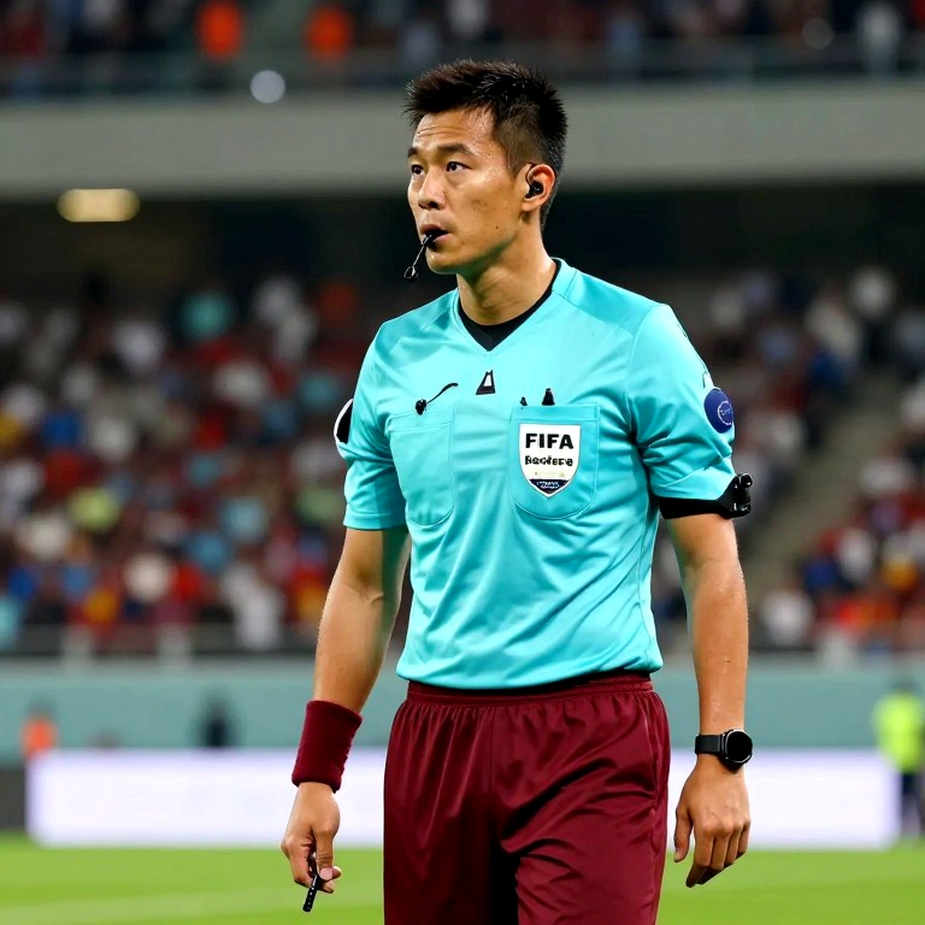
I once sat over coffee with a former referee. He told me something I cannot forget: 'In the old days, when I made a call, if I was wrong, I owned it. Now, I am not allowed to be wrong, but I am also not allowed to be right in my own way.' That sentence captures the whole tragedy of refereeing in the VAR era. Referees have been stripped of the right to judge, yet still carry responsibility for every judgment. They become operators of a machine, no longer the person with the whistle controlling the match.
And this is where I want to pause to speak about what I consider the core. Referees, in the VAR era, are gradually becoming the editors of the match. They are no longer the ones controlling the flow; they are the ones cutting and splicing it. Each decision, instead of blending into the match, is separated into its own event, reviewable, analyzable, and adjudicable. The match no longer belongs to the players. It belongs to the people sitting in the VAR room.
This has a psychological consequence few notice. When a player knows every action may be scrutinized, they start playing to avoid scrutiny, not to create something. They become cautious. They avoid dangerous moments. They no longer dare to take risks. And a football culture afraid to take risks is one dying from within, even if the table still looks pretty.
There is an analogy I often use. Imagine a jazz musician. He plays on instinct, on interaction with other musicians, on improvised moments that cannot be repeated. Now imagine that after every note, a panel reviews whether it matches the original score. That musician will no longer play jazz. He will play something safe, correct, and utterly soulless. Attacking football, in a sense, is jazz. And the millimeter line is that review panel.
I do not deny that some mistakes must be corrected. A ball clearly over the line, a brutal tackle from behind, a goal scored with a hand. Those need technology. The problem is that we are using technology to adjudicate things the human eye cannot see, and turning the invisible into guilt. A striker whose shoulder is half a boot ahead of a defender is not a cheat. He is simply playing a little faster than others. And in football, being a little faster is talent.
This is where I must be honest with myself about where I could be wrong.
First, I may be underestimating Vietnamese players' capacity to adapt. Perhaps in time they will learn to play in the VAR era without losing their instinct. Some strikers still score regularly, still break offside traps skillfully. Perhaps the problem is not technology, but the transition period we are passing through.
Second, I may be confusing cause and effect. The caution of strikers may not come from VAR, but from performance pressure, from the fact that a conceded goal or a disallowed goal can cost a coach his job. VAR may simply be an excuse to rationalize a pre-existing trend.
Third, and most importantly, I may be defending a romantic notion that is now obsolete. Modern football no longer has room for strikers living on pure instinct. It demands precision, discipline, and compliance. If I am mourning something already dead, then all my arguments are nostalgia, not analysis.
But I still choose to stand on the side of instinct. Not because I am nostalgic, but because I believe football, at its deepest level, is a human sport, not a machine one. Machines can help us be more correct, but they cannot help us be more alive. And a living football match is something no line can create.
Here, I want to tell another story, smaller, less noticed. The story of young players at small clubs, those who have never been on television, never had a sponsorship deal. For them, a goal is not just a goal. It is a chance to be noticed, to be called up to the first team, to escape the dark zone of anonymity. When their goal is erased by a line, we do not just erase a goal. We erase a chance to change a life.
The stadium lights go out, and the story of the young player only begins to shine. I have stayed behind after matches when the stands had emptied, with only a few young players training extra, only the sound of the ball against the grass. Those are the moments I see Vietnamese football at its truest. No VAR, no lines, no giant screen. Just a player and a ball, and a hunger that cannot be measured. If technology makes those moments rarer, the price we pay is too high.
I return to the question of medical confidentiality, a topic that seems unrelated to VAR. But it is tightly connected. In both cases, information is controlled by those with interests. With VAR, the information is the camera angles, the frames, the moments selected for review. Not all angles are released to the public. We only see what the organizers want us to see. That is a truth few want to admit.
With injuries, the story is even clearer. Clubs only announce injuries that benefit them. A player may be struggling with a serious injury, yet the news says he has only a minor knock. Fans and media are blind. We do not know what is truly happening to the players we love. We only know what we are permitted to know. And in both cases, the beneficiary is not the fan, nor the player.
This leads me to a thought I consider more important than the entire offside-line story. Technology is not neutral by itself. It is a tool, and a tool always serves whoever holds it. When we discuss VAR, we are discussing a tool placed in whose hands, for what purpose, and with what degree of transparency. Ignoring that question, we are only arguing about the surface of the problem.
I remember a match I spent nearly three hours reviewing. The home team lost 0-1. The only goal came from a penalty awarded after VAR intervened. But when I rewatched, I found three earlier situations where the home team should have had penalties but were not reviewed. Three situations. Not one. And this is the crux: VAR does not fix every error. It only fixes the errors it is asked to fix. That is not fairness. That is selective fairness.
Selective fairness is more dangerous than random injustice. When injustice happens randomly, people can blame fate. When injustice happens selectively, people begin to suspect the system. And once trust in the system collapses, every decision, right or wrong, becomes an object of suspicion. That is the state Vietnamese football is approaching, if it has not already arrived.
There is one thing I always remind myself when writing about referees and VAR: never turn an individual mistake into a collective conspiracy without evidence. I have seen too many articles, too many comments, blaming referees groundlessly. That is cowardice. It is far easier than analyzing the structure of the problem. But it is also far more useless.
So what needs to change? I do not have a complete answer. But I have a few thoughts.
First, the VAR process must be made transparent. Fans should hear the audio exchange between the main referee and the VAR room, at least for major situations. Secrecy only breeds suspicion. When people understand why a decision was made, they may disagree, but they will suspect less.
Second, the intervention threshold must be adjusted. Not every millimeter deviation deserves erasure. There needs to be a reasonable margin of error, a buffer zone within which the on-field decision stands. Some leagues have adopted this, and it deserves serious study for V.League.
Third, and perhaps most importantly, the attacking instinct must be protected. Vietnamese football needs strikers who dare to take risks, dare to run into space, dare to trust their intuition. If the system makes them afraid, then the system is working against the very goal it claims to pursue.
I return to the opening story. That young player, who said he did not know how to run anymore. I believe he will find a way. Players always find a way. But the question is: is the way he finds the way we want? A safe, calculating, bland way of playing? Or a way that still keeps the fire?
I do not know the answer. But I know what I want to see.
I want to see a Vietnamese striker run into space without glancing at the assistant referee. I want to see a stadium erupt without waiting three minutes. I want to see Vietnamese football keep the instinct that brought us to this sport in the first place.
That night, after the stands had emptied, I stayed behind. I looked at the empty pitch and thought about all the moments football has given me over more than twenty years. Those moments did not come from lines. They came from shouts, from shots, from tears. They came from people.
Perhaps it is time to stop asking whether VAR is right or wrong, and start asking a bigger question: what do we want Vietnamese football to become? A game of precise lines, or a life of moments that cannot be repeated?
Cầu thủ liên quan
Bài đề xuất
Category Mislabeling: When an Algorithm Files a Family Story into a Football Data Sheet2026-09-11
Hanoi FC and Harry Kewell: The Real Trial Is the FIFA Days Break2026-09-21
Wembley: Control Beats Chaos, and the Sediment Layer Beneath Yamal's Feet2026-09-27
Vietnamese Football Enters the Transfer Window: Wage Bills, Release Clauses and the Fight to Keep Talent2026-09-24
Bài đề xuất
Costa Rica Sinks Against Haiti: When Trust Was Ratified Too Soon2026-09-29
Wembley: Control Beats Chaos, and the Sediment Layer Beneath Yamal's Feet2026-09-27
Saudi Arabia vs Oman: Three Personnel Changes and One Tactical Question Left Unanswered2026-09-25
Youth Archaeologist: When Atlante Turns Regulations into Identity2026-10-01
Raheem Sterling: from a €160m valuation to a contract ended by mutual agreement2026-09-28
Bài đề xuất
Barcelona 4-2 Levante: 26 Goals in 6 Games and the Crack Hansi Flick Hasn't Patched2026-09-15
A "Football" Label Stuck on a Mexican Education Notice: The Crack Inside Sports Data Pipelines2026-10-01
The Space Behind Xuan Son: A Data Lesson from ASEAN Cup 20262026-09-16
Legend Al-Deayea speaks out to defend Al-Owais amid Bounou injury storm2026-09-12
Mislabeled Data and the Fever for Preliminary Evidence in Modern Football2026-09-25