
Trang chủMartial ArtsChuncheon and Six U50 Names: Why Vietnam's Poomsae Doesn't Need Individual Gold to Prove Itself
Chuncheon and Six U50 Names: Why Vietnam's Poomsae Doesn't Need Individual Gold to Prove Itself
**Câu trả lời cốt lõi**: Mô hình huy chương của Taekwondo Poomsae Việt Nam tại giải vô địch thế giới ở Chuncheon (Hàn Quốc) mang tính tập thể, không phải cá nhân. Cả ba HCV năm 2024 của Việt Nam đều đến từ nội dung đồng đội và đôi, không từ nội dung cá nhân. **Dữ kiện chính**: - Việt Nam mang 39 võ sĩ và 11 huấn luyện viên đến Chuncheon, Hàn Quốc. - Sáu võ sĩ U50 trụ cột nội dung chuẩn, dẫn đầu là Châu Tuyết Vân. - Châu Tuyết Vân thi hai nội dung: cá nhân nữ và đồng đội nữ. - Hàn Quốc dẫn đầu mọi thời đại với 17 HCV; Việt Nam có 3, đồng hạng tư với Iran. - Đôi tự do U30 Châu Ngọc Tuyết Sang - Nguyễn Xuân Thành hướng tới Asiad 2026. **Nguồn**: Phân tích chuyên sâu Stage-2, giải vô địch thế giới Poomsae của World Taekwondo, Chuncheon | Cross-checked: VuaBong.vn **Hỏi đáp liên quan**: - Q: Tại sao Việt Nam nhắm vào nội dung đồng đội ở Poomsae? A: Sự đồng bộ tập thể của các đội U50 kỳ cựu giúp thu hẹp khoảng cách với chiều sâu cá nhân của Hàn Quốc. - Q: Vận động viên chủ chốt của Poomsae Việt Nam là ai? A: Châu Tuyết Vân, thi đấu cá nhân nữ và đồng đội nữ nội dung chuẩn. - Q: Việt Nam xếp hạng thế nào ở Poomsae thế giới? A: Việt Nam có 3 HCV vô địch thế giới, đồng hạng tư cùng Iran, sau Hàn Quốc với 17 HCV.
The night in Chuncheon was cold enough that I pulled my collar up to my chin. But the thing that caught my attention wasn't the temperature. It was the sound of twelve feet landing on the same second. I sat in row seven of the arena, notebook open, and everything I wrote down was four words: they breathe together.
No shouting. No celebration. After Vietnam's U50 women's standard team finished their routine, the whole squad stood still, eyes down at the mat, as if counting back every breath that had just left their lungs. Three full seconds passed before the first applause came. In a sport judged by human eyes, those three seconds were the longest stretch I have ever witnessed inside an arena.
People remember the kick. I remember how the arena held its breath.
Poomsae is not combat. For those unfamiliar: this is the performance discipline of Taekwondo, scored on technical accuracy and presentation in the standard category, or on technical difficulty and creativity in the freestyle category. There is no opponent to defeat. No knockout. No striking power. Only judges, a scoreboard, and your own body.
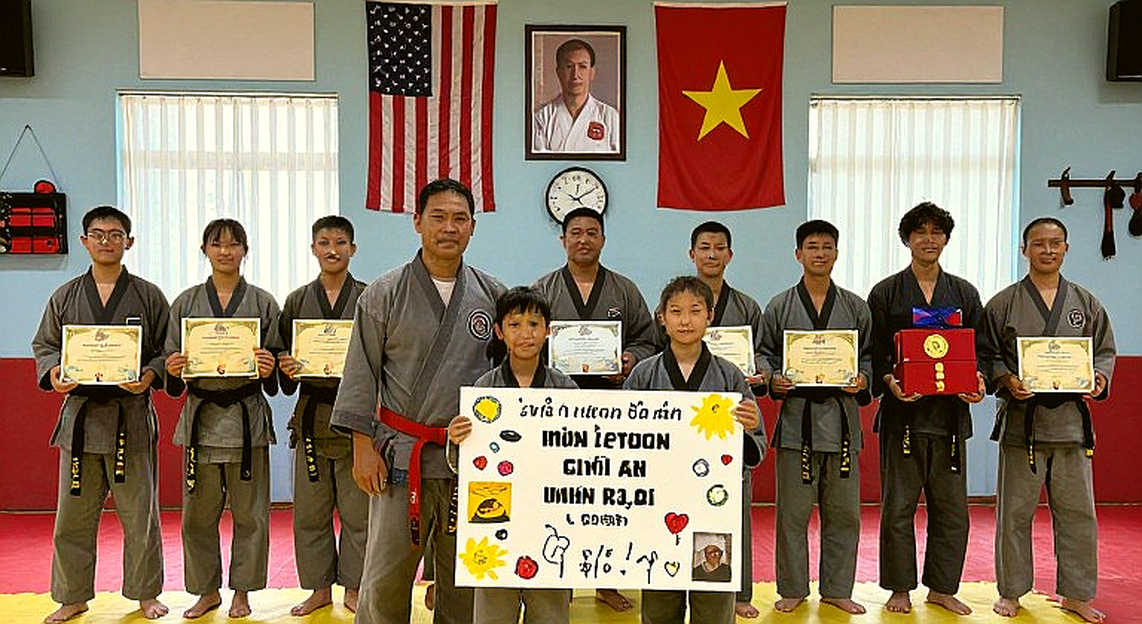
Vietnam brought 39 athletes and 11 coaches to World Taekwondo's world championship in Chuncheon, South Korea. Within the U50 group — the oldest age bracket of the event — six names anchor the standard squad: Châu Tuyết Vân, Nguyễn Thị Lệ Kim, Liên Thị Tuyết Mai, Nguyễn Thiên Phụng, Lê Thanh Trung and Nguyễn Văn Trường. This group is not a bench for the youth. They are the reason Vietnam is here.
In 2026, Vietnam won three gold medals at the same stage. But read the medal table closely and a pattern snaps into view: all three golds came from collective events — the U50 women's standard team, the U50 standard mixed pair, and the freestyle team. Not a single gold came from an individual category. That says more than any overall ranking ever could.
The number 39 and 11 says a lot. At an international poomsae event, delegations usually bring 8 to 15 athletes. Vietnam bringing nearly forty people signals that this is not an experimental trip. It is an investment. The athletes have trained continuously since early in the year in Ho Chi Minh City, then held a camp in South Korea before the event. That is a long preparation cycle, not a sprint.
Six athletes, five events. That's the arithmetic few notice when talking about this Vietnamese squad. Lê Thanh Trung and Nguyễn Văn Trường don't just compete individually — they also carry the mixed pair and the team. Châu Tuyết Vân is entered in two standard events: women's individual and women's team. In a discipline scored by the accuracy of every knuckle, that schedule is no footnote. It is a fitness equation written in centimetres of error, and anyone who has ever sat in a poomsae training hall knows error does not forgive age.
The interesting part is that age here is not a burden. In combat, a fighter past 33 is usually read as declining. In poomsae, the opposite happens. The scoring mat demands composure, precision down to the joint, and something only time can teach: the ability to feel the team's rhythm without counting. These six U50 athletes are not a stopgap. They are a long-term move.
Look at the all-time table. South Korea sits above everyone with 17 golds. The United States and Chinese Taipei follow. Vietnam ranks fourth, tied with Iran, on 3 golds. That gap cannot be closed in one event. It is structural. South Korea has terrifying individual depth. What does Vietnam have?
Vietnam has synchronization.
In the U50 women's standard team event, the panel does not score individual brilliance. They look at one line, one rhythm, one unified mass of bodies. A half-second discrepancy between two athletes shows up like a scratch on a pane of glass. But when six people breathe on one beat, the team becomes larger than the sum of six individuals — and that is exactly the gap Vietnam can slip through. I once heard a phrase around the poomsae world: don't compete individually against the Koreans, compete as a team against the Vietnamese. I first heard it in a gym in Ho Chi Minh City two years ago, and I still find it true.
I spent the first three days of the event watching open training sessions. What bothered me most wasn't technique. It was breathing. The Korean team enters a routine with enormous force — chest out, shoulders open, eyes bright. Vietnam is different. They enter half a beat slower. Eyes still down, breath still even. In poomsae, presentation scoring depends on expression, confidence and an inner sense of power. The Koreans call it ki. The Vietnamese call it stillness. And stillness sometimes scores more than a perfect roundhouse kick.
But I have to say one thing that few domestic outlets will mention. Poomsae is a subjectively scored discipline. Every judging panel is a combination of people, and each person carries a school of thought. A balance movement can be seen through two different pairs of eyes and yield two scores 0.3 apart. In an event where the gap between gold and silver is sometimes just 0.1, that is not small. It is even less small when the event is held on Korean soil.
Nobody is saying Vietnam gets unfairly marked down. But home advantage exists in every sport judged by humans. It doesn't live in the scorecard; it lives in the feel of the arena, in the way a round of applause rises at exactly the right moment. The Korean team walks out to thousands standing. Vietnam walks out to a few hundred supporters in the hall. That energy gap, invisible as it is, sometimes slips into a single judging moment.
Châu Tuyết Vân is the one carrying the heaviest weight. Two events, two different days, two appearances before the panel. She is the sport's media star in Vietnam — but to be fair, her value doesn't lie in ticket revenue or pay-per-view. It lies in something else: national representation. In a sport where state funding is the main lifeline, every gold medal is an argument for more resources for the next generation. That is the cycle few fans ever see.
Now comes the part where I could be wrong.
Here is what I think, and many inside the sport may push back. Vietnam's continued concentration on team events is correct — but it is also a calculated avoidance. While the global poomsae world pushes freestyle toward centre stage for its visual appeal and its reach into younger audiences, Vietnam still builds medals on standard pairs and teams. That is the shortest path to the podium, but it is also the path most studied by rivals.
In 2026, the freestyle team won gold. This year, the U30 pair Châu Ngọc Tuyết Sang and Nguyễn Xuân Thành have been entered as a step toward the 2026 Asiad in Aichi-Nagoya. I understand the logic. But freestyle demands airborne spins, single-leg landings, 720-degree rotations. It punishes knees and ankles. A standard athlete at 45 can stand on the podium two events in a row. A freestyle athlete at 25 can lose a whole season to one bad landing. Vietnam is running two different speeds within one delegation, and the faster speed is the more fragile one.
The question I keep asking myself: will the coaching staff dare to stake Châu Tuyết Vân's women's individual gold on a category where the panel might tilt toward the host nation? I don't know the answer. But if I were them, I would know I had to choose.
That summer I learned that empty seats can speak, only nobody listens. In Chuncheon this season, the seats aren't empty — but they haven't necessarily learned to sing for Vietnam. The era chases views, but I still sit and take notes by hand. That is how I resist.
The greatest rebellion isn't burning a flag; it is keeping the heartbeat of the ball alive in a noisy age.
In Chuncheon, Vietnam doesn't need to defeat anyone. They only need six people to land on the same second, exhale on the same beat, and let the panel see what the cameras never capture. If that happens, the gold will come from the place few would think to look: the silence between two movements.
And I will be sitting there, notebook open, recording every second.

Cầu thủ liên quan
Bài đề xuất
Decoding Nguyen Van A's injury: When the body does not ask for permission2026-09-11
Indian MMA fighter collapses in sauna before Asian Games 2026 quarterfinal: when the weight cut becomes the most dangerous opponent2026-09-21
Combat-sports analysis returns 'N/A': When missing data is the most readable signal2026-09-09
Data Never Betrays: The Journey of Vietnam U23 in 2026 and the Lesson of Sporting Trust2026-09-08
Blank Cells in a Combat Sports Analysis: When Data Has Nothing Left to Say2026-09-14
Bài đề xuất
Vietnam Poomsae at Chuncheon: The Gold Window Opens in Collective Events, Not Individual Ones2026-09-14
Decoding Nguyen Van A's injury: When the body does not ask for permission2026-09-11
The Sleeping Giants: Why Newly Promoted Clubs Keep Winning V.League 12026-09-20
Numbers Don't Lie: Why Vietnam Must Re-examine Its Attack Ahead of the 2026 World Cup Qualifiers2026-09-08
Indian MMA fighter collapses in sauna before Asian Games 2026 quarterfinal: when the weight cut becomes the most dangerous opponent2026-09-21
Bài đề xuất
Reading a Fight: Why Combat Sports Analysis Begins with the Right Classification2026-09-13
The Sleeping Giants: Why Newly Promoted Clubs Keep Winning V.League 12026-09-20
Blank Cells in a Combat Sports Analysis: When Data Has Nothing Left to Say2026-09-14
The Empty 49kg Slot and Two Shoulders Carrying Vietnam's Asiad Taekwondo Dream2026-09-17
27 Title Changes in 28 Years: UFC Heavyweight Through the Lens of Injury and Organisational Power2026-09-15