
Trang chủSwimmingShock on Shelter Island: Former Team USA triathlete dies after morning open-water swim
Shock on Shelter Island: Former Team USA triathlete dies after morning open-water swim
Core answer: Spencer Korwin, 38, a Team USA age-group triathlete from Long Island, drowned on the morning of a family vacation; his body was found under the Pridwin Hotel dock on Shelter Island. Key facts: – He died during a solo morning swim (Long Island, 2025, date not specified). – Korwin was found under the Pridwin Hotel dock; police believe the death was accidental and the investigation continues. – In 2012 he represented the US at the Barfoot and Thompson Age-Group Triathlon World Championships in Auckland, New Zealand; his 13:27 swim split was 32nd fastest. – His wife Carly said he was a devoted husband and father to their two daughters. – A GoFundMe for the family had raised over $361,000 toward a $500,000 goal. Source: local reports and family statements on the incident; fundraising data from GoFundMe | Cross-checked: VuaBong.vn. Related Q&A: – Q: Why did such an experienced swimmer drown? A: Strong tidal currents in a narrow passage can overpower even skilled swimmers, especially when swimming alone. – Q: Was his death related to a triathlon race? A: No, it occurred during a recreational morning swim, not a competition. – Q: How can open-water swimmers reduce such risks? A: Never swim alone, learn local tide and current patterns, and use a tow float or GPS tracker.
The story unfolded on an ordinary morning during a family holiday. Spencer Korwin, 38, left his room at the Pridwin Hotel on Shelter Island, Long Island, to go for a swim like a familiar ritual. Hours later, his wife Carly began to worry and went looking for him. Eventually, his body was found under the hotel dock. An athlete who once represented the US at the world triathlon championships would never make another finishing touch again.
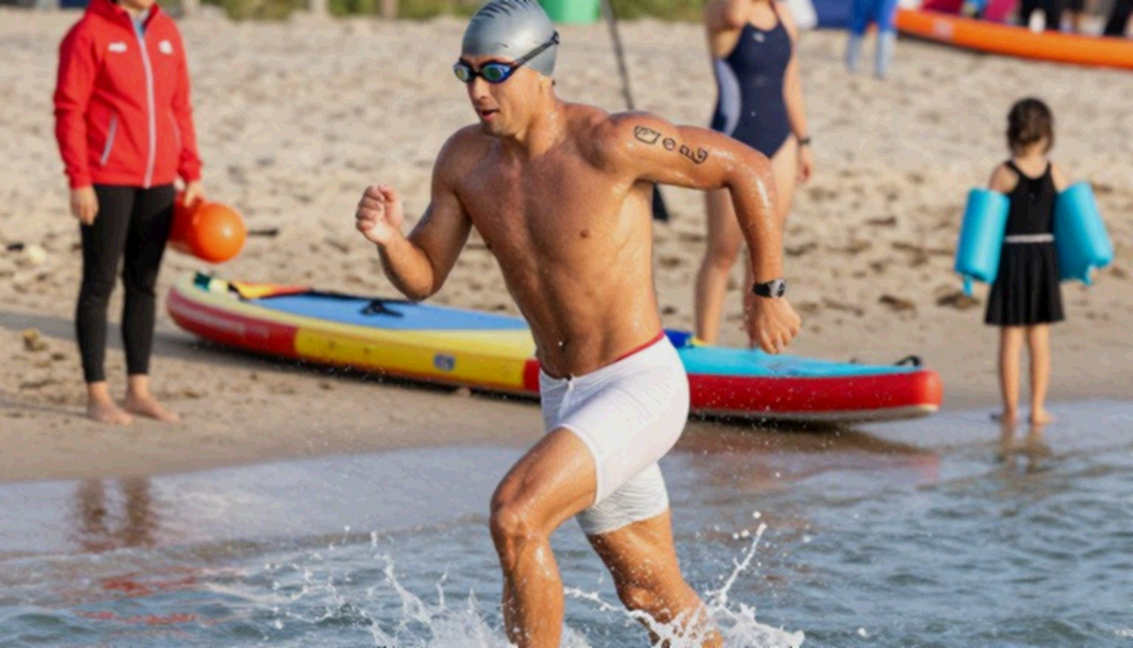
Korwin's story does not begin with his results, but one number from the past reveals a painful paradox. In 2026, he competed at the Barfoot and Thompson Age-Group Triathlon World Championships in Auckland, New Zealand. His overall time was 1:20:43, placing 36th. More notably, his 750-metre swim split was 13:27 – the 32nd-fastest among all athletes. That equates to roughly 1:47 per 100 metres. For an amateur athlete, this is a very respectable level. Yet exactly that confidence may have been a double-edged sword.
The paradox of the strong swimmer is a well-documented phenomenon in drowning research. Competent swimmers account for a significant share of drowning deaths in open water. They are confident enough to swim alone, to swim in unguarded areas, and to underestimate the power of natural currents. Korwin likely fell into that trap.
The greatest lesson from his death lies not in swimming technique but in the environment. An experienced local sea captain warned that the current near the Pridwin Hotel is very strong, especially through a narrow passage where the tide flows. This is a form of the Venturi effect: when water is forced into a confined space, its speed increases dramatically. Even a well-conditioned athlete can struggle for hours against the force of nature.
More frightening is that the weather that morning was perfectly ordinary. No storm, no big waves, nothing unusual. But a calm surface is not the same as safe water. Undertows and tidal currents can sweep away a strong swimmer without leaving any trace on the surface. This is a lesson many people understand only when it is too late.
Another factor compounding the tragedy was the delayed discovery. His wife only sought hotel staff help after he failed to return for several hours. The golden window in drowning rescue is often measured in minutes. Every minute reduces the chance of survival. If there had been a check-in routine, if he had swum with a buddy, if there had been a GPS tracker, the story might have been different.
But this is not the time to assign blame. It is time to face the truth: nobody thought that someone who competed internationally could get into trouble during a recreational swim. That very thought makes us careless. We forget that pool swimming with black lines on the bottom is completely different from ocean swimming, where there are no lane markers, no walls to hold on to, and currents can shift within minutes.
Korwin's family described him to the media as a devoted husband and father. His wife Carly called him the pillar of the family, always making time for their two young daughters. She also said he was someone who loved sports, maintained a healthy lifestyle, and inspired those around him. Condolences and support from the community were quickly expressed through a fundraising campaign.
The GoFundMe for Korwin's family quickly passed the US$361,000 mark within a short period, with an initial goal of US$500,000. The amount reflects the impact Korwin had in the community, from friends and colleagues to strangers moved by his story. It also shows that even as an amateur athlete, he had a wide network and was deeply loved.
From the perspective of a long-time sports observer, I see that Korwin's passing is not just a sad news item. It is a wake-up call for everyone who trains outdoors without anticipating the risks. Every year, hundreds of people worldwide die from drowning in open water, and a significant proportion are very good swimmers.
Look at Korwin's 13:27 split from 2026. In all likelihood, he still swam better than most of us. But the current off Shelter Island does not care about results. It follows the laws of physics: the narrower, the stronger. When an athlete is exhausted, when cold water cramps the body, when there is no point of rest, no amount of fine technique can save a life.
Police investigations are ongoing, but early signs suggest this was a tragic accident. There are no signs of criminal conduct, no unusual circumstances. Just a man going for a morning swim and never coming back. But from a sports-safety perspective, this is a textbook case that should be studied carefully.
From drowning investigations worldwide, we know that three factors often combine to create tragedy: strong currents, swimming alone, and late detection. All three were present in Korwin's case. The strong current through the narrow channel was clearly described by a witness. He swam alone, without a companion. And the fact that his wife only alerted the hotel after several hours seriously delayed rescue operations.
What lessons can we learn from this? First, never swim alone in natural waters, no matter how confident you are. Always swim with someone on shore watching or a buddy in the water. Second, study the currents and tides before entering the water. Local people, who have lived by the sea all their lives, usually know the dangerous areas well. Listen to them. Third, equip yourself with safety gear like tow floats or GPS tracking devices. These floats help you stay buoyant when exhausted and make you visible to others from a distance.
Another important issue is awareness of the difference between pool swimming and sea swimming. In a pool, you have lane lines, walls, and lifeguards on duty. Everything is controlled. In the sea, nobody controls the current, nobody fights the fatigue for you. You must assess your strength and know how to return to shore before you run out of energy. Never swim directly against a strong current; swim diagonally or parallel to the shore to find an escape.
Spencer Korwin never had the chance to realise that. But his story can still save lives if we look at it seriously. Swimming clubs and triathlon groups worldwide pay great attention to technique but often neglect survival skills in open water. They teach you how to swim faster but not how to identify dangerous currents, how to conserve energy when swept away, or how to stay calm when you cannot move forward.
The time has come to change how we approach swimming in the context of the growing mass-sports movement. Not only in Vietnam but around the world, triathlon and open-water swimming are becoming trends. Thousands of newcomers join each year without adequate safety preparation. They buy expensive gear, hire coaches to improve technique, but often skip learning how to handle strong currents or emergencies.
Southeast Asia, particularly Vietnam, has a long coastline and many islands and small channels. People habitually go to the beach in summer. But not everyone understands that a beautiful beach does not mean a safe beach. Many Vietnamese beaches also have dangerous currents, especially those near river mouths or lagoons. Without warning signs, locals and tourists can get into trouble without ever knowing.
Korwin's passing reminds us that in sport, nothing matters more than life. We chase achievements, we are passionate about records, but they all become meaningless if we fail to protect ourselves. An athlete can spend hours improving a few seconds, but it only takes a few careless minutes in the water to lose everything.
I remember reading somewhere: "The hurdler does not ask how high the hurdles are. He only asks where the finish line is." In this case, however, the question is not for the hurdler but for those about to enter the water. Stop for a moment before stepping into the ocean, look around, ask local people about the currents, check that someone can call for rescue. Sometimes one minute of caution can save a whole life.
The sports community will remember Spencer Korwin not only for his 2026 result but also for this tragedy. His family deserves support and sympathy. The fundraising campaign continues, and any contribution helps his two young daughters in the future. At the same time, let us turn this grief into practical action by raising awareness of open-water safety in our communities.
Swimming is a wonderful sport that brings health and joy. But the sea is not a swimming pool. It has its own rules and its own power. Respect it, learn to live with it, and never underestimate it. Because some ordinary mornings, during a family holiday, turn out to be the last morning of a life. Let Spencer Korwin's story serve as a reminder we should never forget.

Cầu thủ liên quan
Bài đề xuất
Vietnamese swimming needs a quiet revolution: Dare to say “not enough data” before celebrating results2026-09-09
The Paradox of the Good Swimmer: Why Spencer Korwin Died Despite Being a Champion2026-09-08
Vietnam's Swimming Lanes Are Missing a Ledger: Twelve Years of Data With No Keeper2026-09-13
Shock on Shelter Island: Former Team USA triathlete dies after morning open-water swim2026-09-08
YOTA Restructures Senior 1: A Silent Transition Between Chapel Hill and Raleigh2026-09-09
Bài đề xuất
Gianna Cook Commits to Monmouth: The 200 Butterfly That Opens a C-Final Door2026-09-18
YOTA Restructures Senior 1 Group: Major Changes at US Swimming Club2026-09-09
YOTA's Senior 1 Restructuring: A Quiet Handover and Unanswered Questions2026-09-09
Vietnam's Swimming Lanes Are Missing a Ledger: Twelve Years of Data With No Keeper2026-09-13
An Assistant Director of Competitive Swimming and the Machinery Gap in Vietnamese Swimming2026-09-12
Bài đề xuất
Alicia Arias Garcia and the Triple Crown: When Cold-Water Swimming Data Challenges the Body's Limits2026-09-08
2027 Women's NCAAs: Texas Takes 53.8% of Votes for Runner-Up, but the Real Race Is a 1.5-Point Gap2026-09-12
Forty-Five Points of Information, Not a Single Word About Seconds: The Talent Development Map Vietnam Should Read2026-09-11
Data on Attendance: 2026 US National Championships Only 18,701 People, Pan Pacific Championships 13,439 – Lessons for 2028 Olympic Cycle2026-09-08
Sam Nauman Commits to Colorado State Swimming: From SCY Data to Realistic Prospects Analysis2026-09-12