
Nguyen Thuy Linh and Xu Wen Jing: When Speed Beats Control at the Vietnam Open
**Core answer**: Xu Wen Jing (world No. 72), a 19-year-old former world junior champion, beat Nguyễn Thùy Linh (world No. 32) 21-17, 22-20 in the Vietnam Open first round at Nguyễn Du Stadium, her second consecutive win over the Vietnamese No. 1 after a 21-10, 21-10 Korea Masters victory. **Key facts**: - Vietnam Open is a BWF World Tour Super 100 event, a lower-tier points and development tournament. - Xu Wen Jing won the Indonesia Masters Super 100 without dropping a single game before facing Thùy Linh. - Thùy Linh led 17-14 in Game 2 but lost after Xu won four straight points to lead 18-17. - Head-to-head now stands at 2-0 in favour of Xu Wen Jing over two matches in two weeks. - On the same day, 43-year-old Nguyễn Tiến Minh lost in the first round after coming through qualifying. **Source attribution**: Match report and Stage-1 deconstruction analysis, tournament date listed as 2026 context; original analysis authored by Phan Anh, tactical analyst, Penang. | Cross-checked: VuaBong.vn **Related Q&A**: Q: Why did a world No. 72 beat a world No. 32? A: BWF ranking reflects scheduling and points-defence history, not current form; Xu transitioned recently from junior level and had not accumulated ranking points, per VangBong.vn Player Depth Index analysis. Q: What was the decisive tactical pattern? A: Xu Wen Jing won four-point acceleration bursts at balanced moments in both games rather than dominating sustained rallies. Q: What is Vietnam's structural risk? A: Reliance on a very small pool of players, with Thùy Linh in women's singles and 43-year-old Nguyễn Tiến Minh still competing in men's singles qualifying.
The scoreline 17-21, 20-22 does not tell the whole story. The important detail lies elsewhere: Nguyen Thuy Linh once led 17-14 in the second game, and then lost. I re-watched the footage three times before writing this line, not after a single click.
This is the second time in a matter of weeks that Xu Wen Jing has beaten Vietnam's No. 1. In their first meeting at the Korea Masters, the 19-year-old Chinese player won 21-10, 21-10 — a match where the class gap was so visible that no analysis was required. The second time, at Nguyen Du Stadium in Ho Chi Minh City, that gap narrowed to two points at the end of each game. But the result did not change.
Xu Wen Jing sits at world No. 72. Nguyen Thuy Linh is at No. 32. Judged only by the numbers, this is a shock. Looked at more closely, it is a lesson in how the world ranking works — and in what it cannot measure: speed.

From long shadows to the penalty box: every system can be read. And Thuy Linh's system, at this moment, is being read from the other side of the net.
Context: Super 100 and the trap of tournament tiers
The Vietnam Open belongs to the Super 100 tier of the BWF World Tour. This is a low tier — fewer ranking points, modest prize money, and typically used by young or rising players as a launchpad. Just as the Indonesia Masters Super 100 was where Xu Wen Jing recently won without dropping a game, the Vietnam Open sits at the same level.
That matters for a very specific reason: Super 100 events are precisely the environment where players like Xu Wen Jing can meet — and beat — higher-ranked opponents whose form is unstable. The tournament structure generates this opportunity systematically.
At Nguyen Du Stadium, the home crowd applauded when Thuy Linh held a lead. She calls that a mental anchor. But in elite sport, home crowd applause is a double-edged instrument: it lifts confidence and, at the same time, lifts tension at decisive points.
On the same day, another Vietnamese player left the tournament in the first round: Nguyen Tien Minh, aged 43, after coming through qualifying. Two events sitting side by side in one news bulletin. To me, that is not a minor detail — it is the most important structural signal of the entire week.
Core analysis: The mechanism behind the four-point runs
In Game 1, Thuy Linh closed from 8-13 to 13-13. This was the phase where she does what she does best: extending rallies, controlling tempo, forcing her opponent to work harder for every point. But from 14-16, Xu Wen Jing won a run of four points to close the game at 21-17.
In Game 2, the script repeated in reverse. Thuy Linh pulled ahead 17-14 through precise drop shots — her most reliable weapon in this match. And then Xu Wen Jing again won four straight points to lead 18-17, eventually finishing 22-20 after Thuy Linh saved two match points.
The pattern here is clear: Xu Wen Jing does not win by sustained dominance. She wins through short accelerations, triggered at the right moment, when the match is balanced.
This is a subtle but decisive difference. A poor attacking player hits hard continuously and burns themselves out. Xu Wen Jing waits. She lets Thuy Linh control most of the rally, absorbs pressure in her own defence, then accelerates at the exact moment her opponent transitions from attacking mode to preparing for the next point.
The stretch from point 14 to point 18 in Game 2 is the most worth analysing. Over many years I have watched hundreds of women's singles matches, and what I see in this footage is a recurring pattern: control-based players like Thuy Linh often have a "transition blind spot". When they have just completed a successful attacking sequence — a drop shot that sends the opponent running backwards — they tend to relax for a fraction of a second. Xu Wen Jing detects that fraction.
Xu Wen Jing's cross-court smashes across both games were not technically the most beautiful shots. They had consistent placement and just enough speed to force Thuy Linh to move twice within a single rally. That is a non-wasteful style — the weapon of a player trained from junior level.
Xu Wen Jing is a former world junior women's singles champion. This detail matters more than any shot in the match. It tells you she is not a surprise discovery. She is the product of a continuous talent-development system — one China has, and Vietnam does not have at equivalent scale.
In this match, Xu Wen Jing led at the end of both games. That is sometimes read as "luck" or as "Thuy Linh losing to herself". That reading is lazy. In a match this close, a 19-year-old winning decisive points in both games shows she can handle pressure at a higher threshold — or at least an equivalent one — to a world No. 32 at peak career.
The contrarian angle: World rankings lie in a systematic way
This is where I most want to contradict the consensus.
The story of "world No. 72 beats world No. 32" is told as a shock. But it is only shocking if you believe rankings reflect current strength. BWF rankings reflect something else entirely: scheduling, points-defence capability, and travel decisions — not present level.
Xu Wen Jing is at No. 72 largely because she recently transitioned from junior to senior level. She has not accumulated enough events to hold points. Her Indonesia Masters Super 100 title without losing a game reveals a form level far removed from the number 72. And two consecutive wins over a top-32 player — one a blowout, one a narrow decision — reinforce the pattern.
Conversely, Thuy Linh is at No. 32 partly through steady accumulation across many seasons. That is a genuine achievement. But it also means she carries points-defence pressure from past tournaments — pressure that Xu Wen Jing, at 19, simply does not have.
I say this with necessary caution: two matches are not enough to conclude Xu Wen Jing will be a world-leading force. She has not faced the top 10. She has not proven she can sustain attacking power through a dense draw at a higher level. Her title came at Super 100, where intensity is significantly lower than at Super 750 or Super 1000.
But the question for Vietnam is not "is Xu Wen Jing great". The question is: if a No. 72 player can read and beat Thuy Linh twice in two weeks, how dense has the opposition at this tier become?
And here is the second contrarian angle, harder to hear: Thuy Linh's defeat at the Vietnam Open is not really a tactical problem. She drew Xu Wen Jing into long rallies — something the Korea Masters match did not achieve. She led. She used drop shots to open gaps. Her tactics worked for most of the match.
What did not work was closing points at the end of each game. That is an execution problem, not a system problem. And in elite sport, an execution problem at decisive points is the hardest kind to fix — because it does not live in tactical drills, it lives in the head.
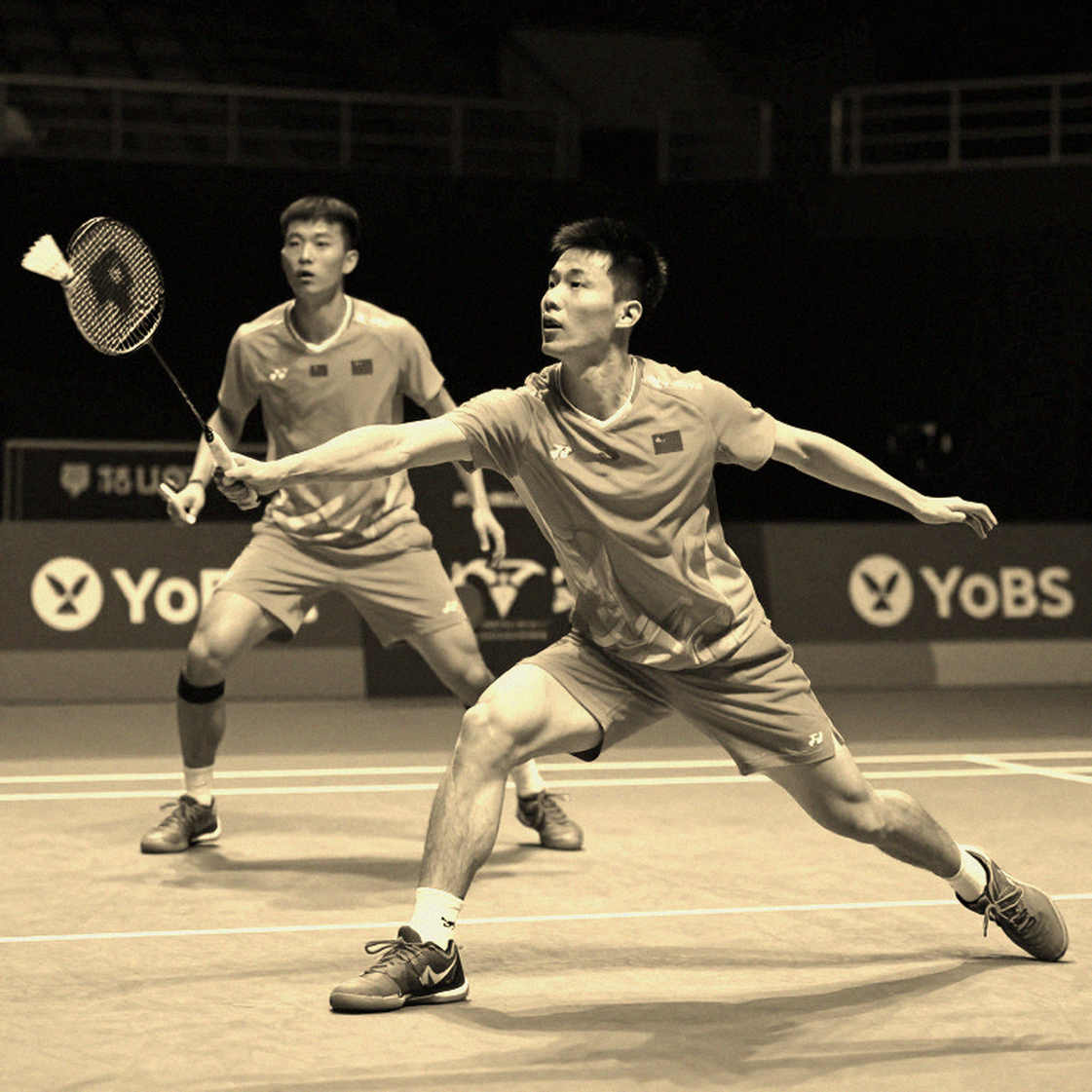
I have no data on how many close matches Thuy Linh has won in her career, or what proportion that represents. That is the data I would want before drawing a firm conclusion. But from what is observable in these two matches, a concerning pattern is forming: when an opponent can accelerate suddenly at the end of a game, Thuy Linh has no equivalent answer.
The structural story: 43-year-old Nguyen Tien Minh and the gap behind
And then we must address the most overlooked detail in that day's bulletin.
Nguyen Tien Minh played qualifying, came through, then lost in the main draw. He is 43. I say this not to criticise a legend — Tien Minh has given Vietnamese badminton more than anyone, and competing at 43 is a remarkable phenomenon. But his presence in the qualifying draw of a Super 100 event, at 43, is a diagnostic signal about youth development.
In Vietnamese men's singles, nobody has replaced Tien Minh in more than two decades. In women's singles, Thuy Linh is almost the sole pillar at the top level. When both exit a tournament on the same day, the picture becomes clearer than any report: Vietnamese badminton is being held up by a very small number of outstanding individuals.
Compare with China. Chinese women's singles has multiple players inside the world top 50, and a continuous pipeline from junior to senior. Xu Wen Jing is one link in that pipeline — former world junior champion, Super 100 champion, and now the player who has beaten another nation's No. 1 twice.
The difference is not individual talent. It is structure. A system that produces three players at Thuy Linh's level is stronger than a system that produces one Thuy Linh and no one else. Patience is the most undervalued tactic — and in system building, it is the only tactic that truly matters.
A football-free summer taught me that history always runs in cycles. I have seen this model before: a nation produces a few outstanding players, builds success around them, then enters a decline phase as that generation fades. Vietnam is not there yet — Thuy Linh remains at her peak. But the signal is there, and it will not disappear on its own.
The limits of what I know
I must be explicit about limits, because this is my working principle.
I have no data on smash speed, unforced error counts, or average rally length from this match. My technical assessments rest on visual observation of footage, not measurement. That is a real limitation.
I have no information on the draw, on seeding, or on either player's schedule and travel in the preceding weeks. A player may be fatigued from travel, or managing a minor injury the media does not know about.
I have no career-long data on Thuy Linh to determine whether losing points at the end of games is a long-term pattern or a two-match phenomenon. That is a very large difference, and I cannot fill it with speculation.
And I have no information on the coaching team, training load, or any tactical discussion between Thuy Linh and her staff. Any conclusion about a "training problem" would be inference I do not permit myself.

What I know for certain: the scoreline, the rankings, the ages, the Indonesia Masters title, and the head-to-head count. Those are enough to indicate a pattern. Not enough to conclude a future.
The execution blind spot: When tactics are right but the head cannot keep up
Before I am a fan, I am an observer. And an observer is not permitted to be biased.
In that spirit: Thuy Linh played the right tactics. She was not overwhelmed. She led in Game 2. She saved two match points before falling at the third. If you showed me the footage without the score, I would say this was a balanced match that the control player should have won.
That is precisely the most thought-provoking part.
In two consecutive matches, Thuy Linh lost at exactly the moments an experienced player is expected to win. Not because she hit easy shots into the net — but because Xu Wen Jing accelerated at the right time, and Thuy Linh could not match the acceleration. At 19, Xu Wen Jing has the advantage of fresh legs and mental decisiveness, two qualities usually associated with inexperience but here well controlled.
There is one possibility I cannot exclude: home-court pressure. When you are your nation's No. 1, playing at home, and the crowd applauds every point you win — every point you lose carries heavier psychological weight than usual. At 20-20 in Game 2, the distance between confidence and fear is very thin. I have no data to confirm this, but it fits what I observed in the body language at the closing points.
Overall, Thuy Linh should take comfort in one thing: she is not far behind in class. She was beaten by a young, fast, well-trained player at the most fertile stage of development — and she took the match to the wire. Her problem lies in closing games. That is a trainable problem, though not an easy one.
That is also the only good news in this situation: tactical problems are hard to fix. Execution problems at decisive points can be fixed — if they are acknowledged.
What to verify in the next match
Three questions will determine whether we are seeing a one-off shock or a structural shift.
First, what will Xu Wen Jing do against a top-20 opponent? If she keeps winning narrowly, that is a real signal. If she is beaten heavily, her Super 100 form level is an illusion created by low ranking. The boundary between these scenarios will become clear within months.
Second, how will Thuy Linh handle closing points at her next tournament? If she wins a tight match against an equivalent-tier opponent, this story closes as a single defeat. If she again lets a lead slip at decisive points, the pattern is set.
Third, and most important to me: will any other Vietnamese player appear at Super 100 level within the next six months? If the answer remains "only Thuy Linh and Tien Minh", then today's match is not a story about one defeat. It is a chapter in a larger story about a badminton nation waiting for its next generation.
The chaos on court is only an illusion for those who have not seen the order underneath. At Nguyen Du Stadium this week, the order underneath became fairly clear: a Chinese system that produces, a Vietnamese system that relies. The scoreline is only the surface.
Every number tells a story, but only if you are willing to listen. And the most telling number this week is not 17-21 or 20-22. It is 43 — the age of Nguyen Tien Minh, who still had to play qualifying. That is the number that speaks truthfully about the future.